In the spring of 2020, during the first UK lockdown, I wrote an article for the British Library English and Drama blog, titled ‘Writing tools for Interactive Fiction’. Quite a few things have changed since then and as the Library launched its first exhibition on Digital Storytelling this June, it seemed like the perfect time to update this list with a few additions.
Interactive fiction (IF), or interactive narrative/narration, is defined as “software simulating environments in which players use text commands to control characters and influence the environment.”
The British Library has been collecting examples of UK interactive fiction as part of the Emerging Formats Project, which is a collaborative effort from all six UK Legal Deposit Libraries to look at the collection management requirements of complex digital publications. Lynda Clark, the British Library Innovation Fellow for Interactive Fiction, built the Interactive Narratives collection on the UK Web Archive (UKWA) during her placement. Because of Legal Deposit Regulations, most of the items in the Interactive Narratives collection can only be accessed on Library premises – which also extends to other collections in the UK Web Archive, such as the New Media Writing Prize collection.
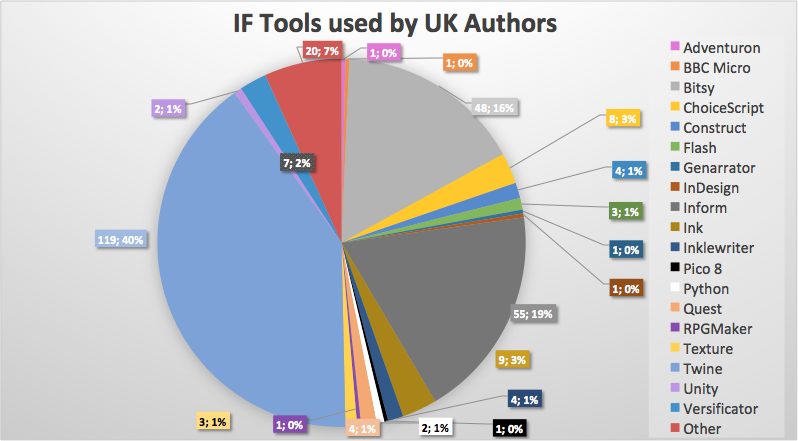
Lynda also conducted analysis on genres, interaction patterns and tools used to build these narratives.
Many of these tools are free to use and don’t require any previous knowledge of programming languages. This is not meant to be an exhaustive list, but it might be a useful overview of some of the tools currently available, if you’d like to start experimenting with writing your own interactive narrative. We are also very excited to be able to offer a week-long Interactive Fiction Summer School this August at the Library, running alongside the Digital Storytelling exhibition.
For an easier navigation, these are the tools included in this article:
Twine
Twine is an open-source tool to write text-based, non-linear narratives. Created by Chris Klimas in 2009, Twine is perfect to write Choose Your Own Adventure-like stories without knowing how to code. The output is an HTML file, which facilitates publishing and distribution, as it can be run on any computer with an Internet connection and a web browser. If you have any knowledge of CSS or Javascript it’s possible to add extra features and specific designs to your Twine story, but the standard Twine structure only requires you to type text and put brackets around the phrases that will become links in the story (linking to another passage or branching into different directions). There is an online version or a downloadable version that runs on Windows, MacOS and Linux. Twine has multiple story formats, with different features and ways to write the interactive bits of your story. The Twine Reference is a good place to start, but there is also a Twine Cookbook (containing ‘recipes’, instructions and examples to do a variety of things).
Some quality cat dreams.
(from Emma Winston’s Cat Simulator 3000)
As the most used tool in the UKWA collection, there are many examples of IF written in Twine, from cat and teatime simulators (Emma Winston’s Cat Simulator 3000 and Damon L. Wakes’ Lovely Pleasant Teatime Simulator), to stories that include a mix of video, images and audio (Chris Godber’s Glitch), and horror games made for Gothic Novel Jam using the British Library’s Flickr collection of images (Freya Campbell’s The Tower – NB some content warnings apply). Lynda Clark also authored an original story as a conclusion to her placement: The Memory Archivist incorporates many of the themes emerged during her research and won The BL Labs Artistic Award 2019.
ink/inky & inklewriter
Cambridge-based video game studio inkle is behind another IF tool – or two. Ink is the scripting language used to author many of inkle’s videogames – the idea behind it is to mark up “pure-text with flow in order to produce interactive scripts”. It doesn’t require any programming knowledge and the resulting scripts are relatively easy to read. Inky is the editor to write ink scripts in – it’s free to download and lets you test your narrative as you write it. Once you’re happy with your story, you can export it for the web, as well as a JSON file. There’s a quick tutorial to walk you through the basics, as well as a full manual on how to write in ink. ink was also used to write 80 Days, another work collected by the British Library as part of the emerging formats project and currently exhibited as part of the Digital Storytelling exhibition.
A page from 80 Days, written using ink. To read in full detail, please click on the image.
inklewriter is an open-source, ready-to-use, browser-based IF “sketch-pad”. It is meant to be used to sketch out narratives more than to author fully-developed stories. There is no download required and the fact that it is a simple and straightforward tool to experiment with IF makes it a good fit for educators. Tutorials are included within the platform itself so that you can learn while you write.
This year’s Interactive Fiction Summer School at the British Library will teach attendees how to write interactive fiction using ink, with a focus on dialogue and writing with the player in mind. Dr. Florencia Minuzzi will lead the 5-day course, together with a number of guest speakers whose work is featured in the Digital Storytelling exhibition – including Corey Brotherson, Destina Connor, Dan Hett and Meghna Jayanth. The school runs from Monday 21st to Friday 25th August – no previous coding experience necessary!
A screenshot from 80 Days Ⓒ inkle.
Bitsy
Bitsy is a browser-based editor for mini games developed by Adam Le Doux in 2016. It operates within clear constraints (8×8 pixel tiles, a 3-colour palette, etc.), which is actually one of the reasons why it is so beloved. You can draw and animate your own characters within your pixel grid, write the dialogue and define how your avatar (your playable character) will interact with the surrounding scenery and with other non-playable characters. Again, no programming knowledge is necessary. Bitsy is especially good for short narratives and vignette games. After completing your game, you can download it as an HTML file and then share it however you prefer. There is Bitsy Docs, as well as some comprehensive tutorials and even a one-page pamphlet covering the basics.
Shout-out to the Emerging Formats Project
(from Giulia Carla Rossi’s The British Library Simulator)
To play (and read) a Bitsy work you should use your keyboard to move the avatar around and interact with the ‘sprites’ (interactive items, characters and scenery – usually recognisable as sporting a different colour from the non-interactive background). You can wander around a Zen garden reflecting on your impending wedding (Ben Bruce’s Zen Garden, Portland, The Day Before My Wedding), alight the village fires to welcome the midwinter spirits (Ash Green’s Midwinter Spirits), experience a love story through mixtapes (David Mowatt’s She Made Me A Mix Tape), or if you’re still craving a nice cuppa you can review some imaginary tea shops (Ben Bruce’s Five Great Places to Get a Nice Cup of Tea When You Are Asleep). You can even visit a pixelated version of the British Library and discover more about our contemporary and digital collections with The British Library Simulator.
Inform 7
While Twine allows you to write hypertext narratives (where readers can progress through the story by clicking on a link), Inform 7 lets you write parser-based interactive fiction. Parser-based IF requires the reader to type commands (sometimes full sentences) in order to interact with the story.
How to Play Interactive Fiction (An entire strategy guide on a single postcard)
Inform 7 is a free-to-use, open-source (as of April 2022) tool to write interactive fiction. Originally created as Inform by Graham Nelson in 1993, the current Inform 7 was released in 2006 and uses natural language (based on the English language) to describe situations and interactions. The learning curve is a bit steeper than with Twine, but the natural language approach allows for users with no programming experience to write code in a simplified language that reads like English text. Inform 7 also has a Recipe Book and a series of well-documented tutorials. Inform also runs on Windows, MacOS and Linux and lets you output your game as HTML files.
While the current version of Inform is Inform 7, narratives using previous versions of the system are still available – Emily Short’s Galatea is always a good place to start. You could also explore mysterious ruins with your romantic interest (C.E.J. Pacian’s Love, Hate and the Mysterious Ocean Tower), play a gentleman thief (J.J. Guest’s Alias, the Magpie) or make more tea (Joey Jones’ Strained Tea).
ChoiceScript
ChoiceScript is a javascript-based scripting language developed by Adam Strong-Morse and Dan Fabulich of Choice of Games. It can be used to write choice-based interactive narratives, in which the reader has to select among multiple choices to determine how the story will unfold. The simplicity of the language makes it possible to create Choose-Your-Own-Adventure-style stories without any prior coding knowledge. The ChoiceScript source is available to download for free on the Choice of Games website (it also requires writers to have Node.js installed on their machine). Once your story is complete, you can publish it for free online. Otherwise, Choice of Games offer the possibility of publishing your work with them (they publish to various platforms, including iOS, Android, Kindle and Steam) and earn royalties from it. There is a tutorial that covers the basics, including a Glossary of ChoiceScript terms. The Choice of Game blog also includes some articles with tips on how to design and write interactive stories, especially long ones.
Genres of works built using ChoiceScript are again quite varied – from sci-fi stories exploring the relationships between writers and readers (Lynda Clark’s Writers Are Not Strangers), to crime/romantic dramas (Toni Owen-Blue’s Double/Cross) and fantasy adventures (Thom Baylay’s Evertree Inn).
Downpour
Downpour is a game-making tool for phones currently in development. Created by v buckenham, Downpour is a tool that will allow users to make interactive games in minutes, only using their phone’s camera and linking images together. There is no expectation of previous programming knowledge and by removing the need to access a computer, Downpour promises to be a very approachable tool. Release is currently planned for 2023 on iOS and Android – if you want to be notified when it launches you can sign up here.
Downpour banner.
More resources
As I mentioned before, this is in no way a comprehensive list – there are a lot of other tools and platforms to write IF, both mainstream as well as slightly more obscure ones (Ren’Py, Quest, StoryNexus, Raconteur, Genarrator, just to mention a few). Try different tools, find the one that works best for you or use a mix of them if you prefer! Experiment as much as you like.
If you’d like to discover even more tools to build your interactive project, Everest Pipkin has an excellent list of Open source, experimental, and tiny tools.
Emily Short’s Interactive Storytelling blog also offers a round-up of very interesting links about interactive narratives.
If you want to be inspired by more independent games and interactive stories, Indiepocalypse offers a curated selection of video and/or physical games in the form of a monthly anthology.
To conclude, I’ll leave you with a quote by Anna Anthropy from her book Rise of the Videogame Zinesters:
“Every game that you and I make right now […] makes the boundaries of our art form (and it is ours) larger. Every new game is a voice in the darkness. And new voices are important in an art form that has been dominated for so long by a single perspective. […]
There’s nothing to stop us from making our voices heard now. And there will be plenty of voices. Among those voices, there will be plenty of mediocrity, and plenty of games that have no meaning to anyone outside the author and maybe her friends. But […] imagine what we’ll gain: real diversity, a plethora of voices and experiences, and a new avenue for human beings to tell their stories and connect with other human beings.”
This post is by Giulia Carla Rossi, Curator for Digital Publications